His Father Pulled a Rickshaw to Educate His Family. Years Later, That Struggle Inspired a Mission Reaching 7,650 Rural Children
BusinessManasi Praharaj22 Oct 2026
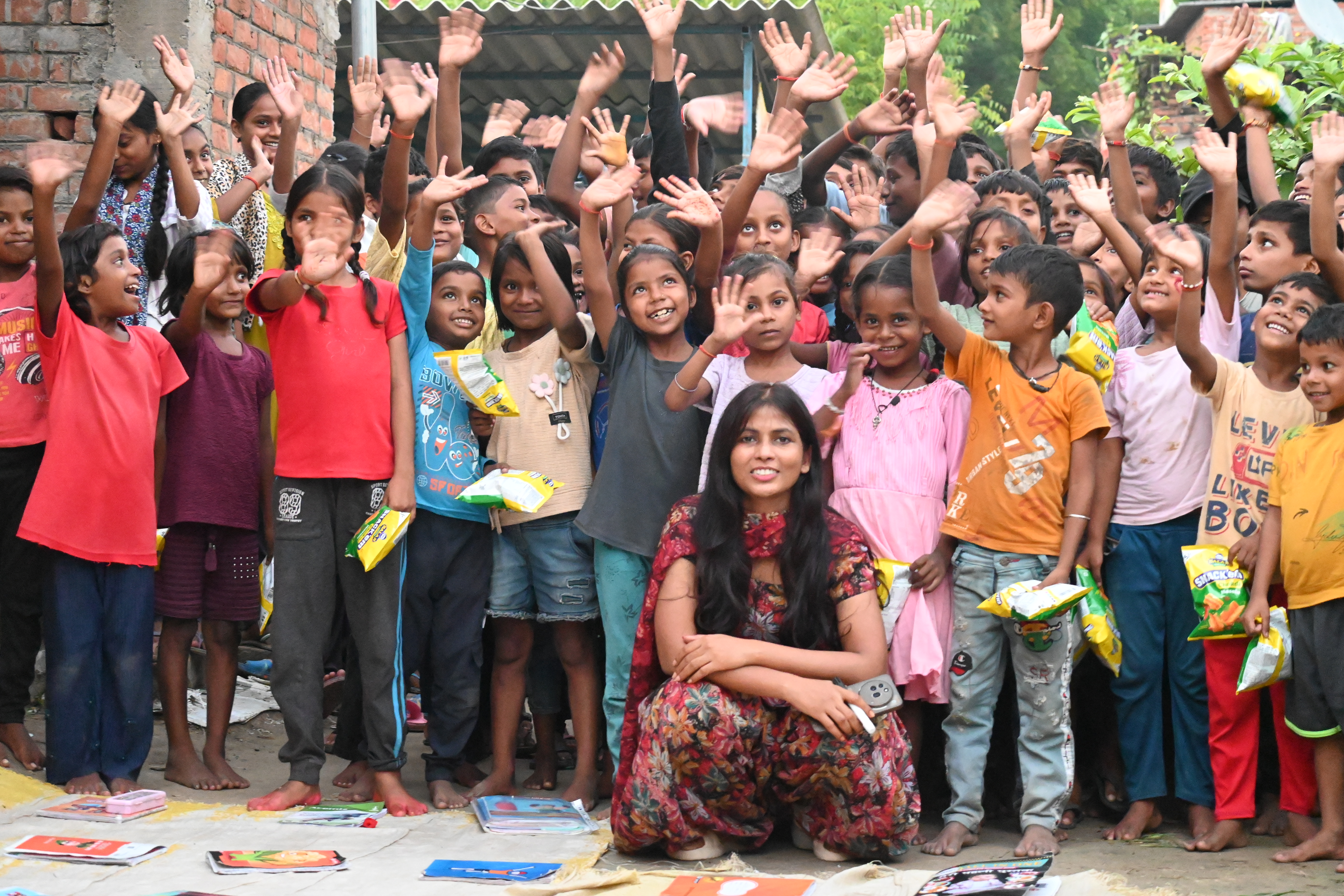
How Archana Jaisal and Manish Kumar are rewriting the story of rural education in Uttar Pradesh, one village, one classroom, and one opportunity at a time.
What does it take to change the future of a child born into poverty?
Sometimes, it takes just ₹100 a month, or even ₹1. Sometimes, it takes a teacher willing to travel to a remote village. And sometimes, it takes two people who refuse to accept that where a child is born should determine how far that child can go.
In rural Uttar Pradesh, where access to additional learning support remains out of reach for many families, Archana Jaisal and Manish Kumar are working to change that reality through Shiksha Saathi.
Their initiative has reached more than 7,650 children through over 78 learning centres across six districts. Through the Yuva Pratibha Pariksha, it has also reached more than 42,370 students. But these numbers tell only half the story.
The other half is about a father who pulled a rickshaw to give his children an education, young women discovering financial independence for the first time, and entire communities beginning to see education as a possibility rather than a privilege.
It Began With a Rickshaw, a Father's Determination, and a Dream
Long before Shiksha Saathi came into existence, Archana Jaisal witnessed the extraordinary lengths to which a parent could go to educate his children.
Her father, Jagdish Ram, began pulling a rickshaw at just 17 to support his family. Despite his financial struggles, he refused to give up on his own education. He continued studying while working, completed his graduation, and eventually secured a job with the Railways.
His journey changed the course of his family's life.
For Archana, it also left behind something far more valuable than financial security: the belief that education could break the cycle of disadvantage.
But life tested that belief.
After her father passed away, the family once again faced financial uncertainty. Her elder sister stepped
forward to support the household, helping Archana continue her education.
Archana, too, took responsibility for her future. She began travelling to other people's homes to provide tuition, using the money she earned to support her education and continue her studies.
Eventually, she completed her postgraduate degree in Economics from Banaras Hindu University (BHU).
She understood what education had made possible for her family. She also understood how easily those possibilities could disappear for children who lacked the same support.
Years later, that understanding would become the foundation of Shiksha Saathi.
The Children Were Going to School. But Were They Really Learning?
While interacting with children in rural communities, Archana encountered a troubling contradiction.
Many children were enrolled in school. They attended classes and progressed from one grade to the next.
Yet some struggled with fundamental concepts they were expected to have learned years earlier.
For families already struggling to make ends meet, private tuition was often an additional expense they simply could not afford.
The problem was not a lack of ambition among children or their parents. It was the lack of accessible learning support that could turn that ambition into academic progress.
Instead of waiting for a large institution to address the challenge, Archana decided to act.
The initiative she began in 2022 evolved into Shiksha Saathi, which was formally established in 2023.
Alongside Manish Kumar, the organisation's founding journey grew around a shared belief: meaningful change must reach children where they live, learn, and grow.
Their approach was simple in principle but ambitious in execution: bring affordable learning support to villages, involve local communities, and create opportunities for women to become educators.
Not Every Child Needs a Big School. Sometimes, They Just Need Someone Who Believes in Them.
Shiksha Saathi's community learning centres provide academic support to students from Classes 1 to 12, with monthly fees starting at approximately ₹100.
Children whose families cannot afford even these modest fees can receive support so that financial hardship does not become a barrier to learning.
Today, the initiative operates across Bhadohi, Varanasi, Mirzapur, Prayagraj, Mau, and Ghazipur.
For a child struggling to keep pace with school lessons, a nearby learning centre can mean individual attention, greater confidence, and another opportunity to understand what once seemed impossible.
For parents, it offers a more affordable way to support their children's education.
And for communities, it demonstrates that improving learning outcomes does not always require expensive infrastructure. Sometimes, it begins with a dedicated educator, a modest classroom, and a collective commitment to children's futures.
The Second Revolution Is Happening Outside the Classroom
What makes Shiksha Saathi's approach particularly meaningful is that its impact extends beyond children.
In many rural communities, educated young women face limited employment opportunities, even when they have the ability and willingness to work.
Shiksha Saathi saw an opportunity to address two challenges through one model.
By training local women as educators, the organisation could improve access to learning while creating livelihood opportunities within villages.
Through its Educator Training Programme, more than 740 girls and women have received training in teaching skills and classroom management.
Among them is Nitu, who began teaching at the age of 19.
With training and support, she started earning approximately ₹6,000–₹7,000 a month, helping her finance her own education.
For someone living in a metropolitan city, that amount might seem modest.
For a young woman building her independence, it can represent something far greater: the ability to make her own decisions, pursue her aspirations, and contribute to her family's financial well-being.
And every time a woman becomes an educator, she creates opportunities for more children to learn.
One opportunity begins to multiply into many.
When a Village Starts Believing, Change Becomes Bigger Than Its Founders
Building trust within rural communities was not automatic.
Families had to be convinced of the value of additional learning support. Young women needed encouragement to pursue teaching. Suitable classroom spaces had to be identified, and resources were limited.
But as communities began witnessing the initiative's work, support started coming from unexpected places.
In one village, a businessman based in Mumbai offered his house to be used as a learning centre and helped arrange essential facilities.
It was more than a contribution of physical space.
It represented the kind of community ownership that grassroots initiatives need to survive and grow.
Shiksha Saathi's journey illustrates an important lesson in philanthropy: meaningful social change is not measured only by how much money is donated. It is also measured by how effectively people, resources, and opportunities are brought together to address a shared problem.
A classroom offered by one person, time contributed by another, and a teacher trained within the community can collectively create opportunities that outlast any individual contribution.
Two Founders, Thousands of Dreams, and a Mission Still Unfolding
For Archana Jaisal and Manish Kumar, Shiksha Saathi is not simply about increasing the number of learning centres.
It is about challenging the belief that children in underserved communities must settle for fewer opportunities.
It is about helping a young girl imagine a career beyond the limitations she sees around her.
It is about enabling a parent to dream of a different future for their child.
And it is about building a model in which communities do not merely receive support but actively participate in creating change.
The initiative has already reached more than 7,650 students, established over 78 learning centres, and helped train hundreds of women. Its youth development activities also encourage students to explore their talents and aspirations beyond conventional classroom learning.
Yet the larger challenge remains significant.
Across rural India, many children continue to face learning gaps, limited access to academic support, and financial constraints that can shape their educational journeys.
Shiksha Saathi's work offers one community-led response to that challenge, demonstrating how affordable education and local livelihood generation can reinforce one another.
A Father's Dream Is Now Creating Opportunities for Thousands
There is something profoundly meaningful about the journey that connects Archana's father to the children studying at Shiksha Saathi's centres today.
A young man once pulled a rickshaw because he believed education could give his family a better life.
Decades later, his daughter, alongside Manish Kumar, is helping thousands of children access learning opportunities that might otherwise remain beyond their reach.
Jagdish Ram may never have imagined that his determination would one day inspire an initiative touching so many lives.
But that is often how lasting change begins.
Not with a grand announcement.
Not with extraordinary wealth.
But with one person's refusal to accept that hardship must be inherited by the next generation.
Because the true measure of progress is not how far the privileged can go. It is how many more people are finally given the chance to move forward.
And in the villages of Uttar Pradesh, that chance is beginning with a classroom.
